Reflecting on Reliability: How Open eLMS Ensures Accuracy in AI-Generated Learning

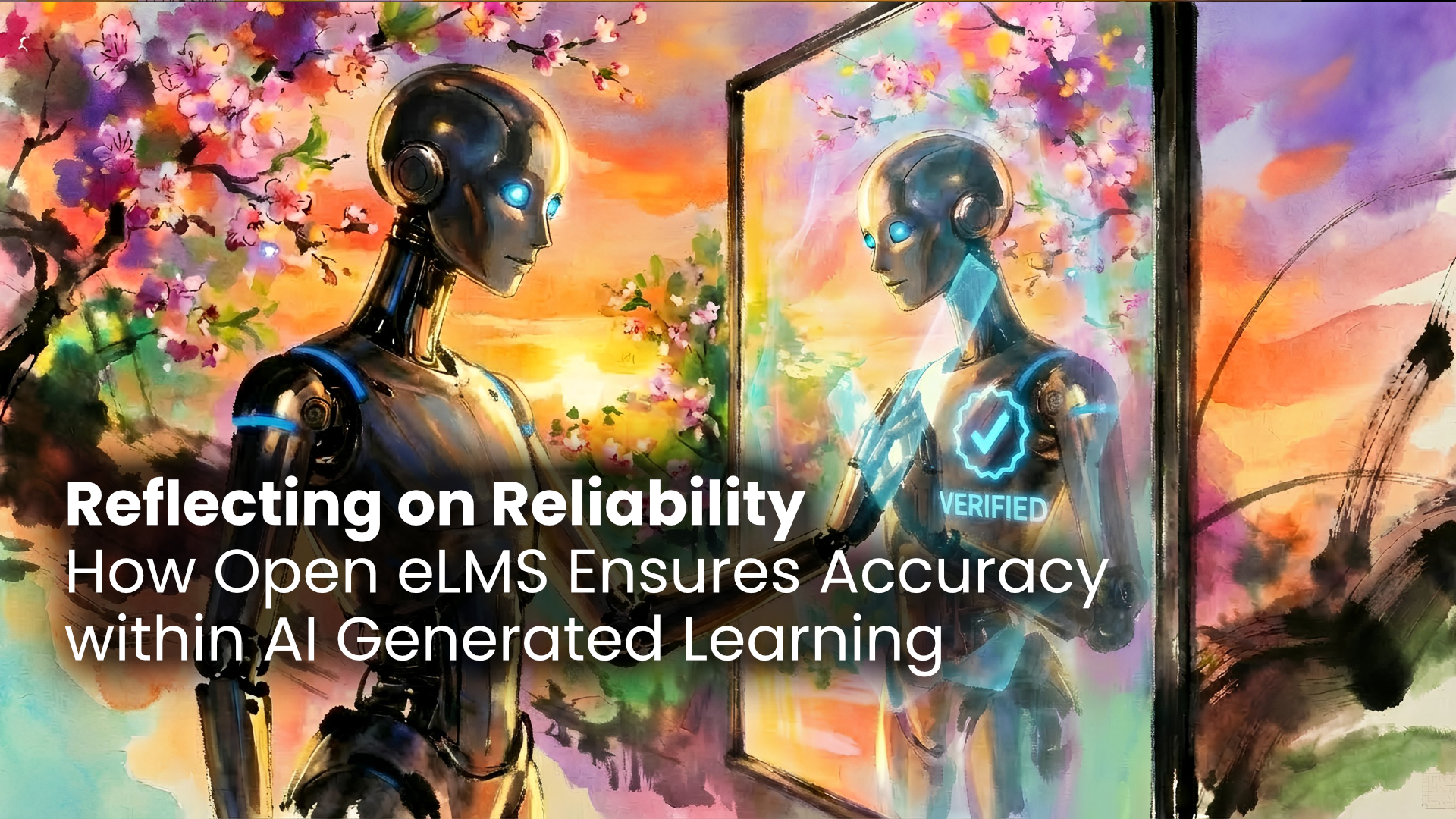
One of the primary concerns surrounding AI in education is as simple as it is justified: What happens when AI gets it wrong?
Anyone who has used generative AI knows it can sound authoritative while being factually wrong. In education and training, this isn't just a flaw—it's a deal-breaker. Inaccurate content doesn’t just waste time; it erodes trust and creates real risks for learners and organisations.
The future of AI in learning won't be defined by speed alone, but by trust. Trust isn't automatic; it must be built, layer by layer.
The Real Problem with AI in Education
Most discussions about AI in education focus on speed and cost savings. While these benefits are real, they are only part of the story. The more critical question is: can the content be trusted?
AI systems do not understand "truth." They are trained on vast datasets and generate language based on probability rather than fact. They can hallucinate, repeat outdated information, or present errors with total confidence. In learning, where accuracy is paramount, this is a significant challenge.
Why One Layer of Checking Is Not Enough
In traditional e-learning, a single instructional designer or subject matter expert often carries the full weight of content validation. This inherently introduces risk; if one person misses an error, it remains in the final product.
Replacing humans with AI doesn't solve the problem—it can amplify it. Without rigorous oversight, AI risks producing inaccurate content at scale.
Trustworthy learning content requires more than a single pass; it demands multiple, complementary layers of verification.
How Trustworthy AI Learning Is Actually Built
The right approach starts by recognising that different content types require specific AI tools. Background imagery might use visual models trained for contextual design, while diagrams, equations, and technical visuals require models specialised in structure, logic, and mathematical precision.
This is only the first step. Once the initial content is generated, human experts step in. Subject matter professionals correct errors, add nuance, and ensure the material aligns with current industry standards.
A final AI layer then scans the entire course for inconsistencies, outdated information, or missed connections. By providing suggestions based on the latest research, it creates a continuous quality loop: AI checks human inputs, and humans verify AI-generated material.
This process catches hallucinations, reduces blind spots, and strengthens accuracy over time.
Why This Approach Produces Better Learning Content
When AI and human expertise collaborate, their strengths complement each other. AI provides speed, consistency, and pattern recognition, while humans contribute critical thinking, professional judgement, and experience.
The result is more robust, accurate learning content. Because the process is modular and repeatable, updates are seamless. When facts change, content adapts quickly rather than becoming obsolete. Trust is no longer assumed; it is engineered.
From Verified Learning to Scalable Delivery
Once multi-verified content is established, it serves as the foundation for broader applications.
Using the Open eLMS Learning Generator, this core content can be instantly transformed into various formats—all derived from the same verified source. A single course can become a podcast, a video series, revision notes, flashcards, or assessment questions.
Each format supports different learning styles, and because the foundation is thoroughly vetted, every version maintains the same high level of reliability.
What This Means for the Future of AI in Learning
AI doesn't need to replace educators to transform learning. Its greatest potential lies in supporting them—enhancing their reach, amplifying their expertise, and improving quality at scale.
The future belongs to learning systems that treat accuracy as essential, not optional—systems that combine AI efficiency with human intelligence, ensuring no content is published without dual verification.
Trustworthy AI-generated learning doesn't happen by chance; it is the result of deliberate design, structure, and rigorous processes.
Ready to See It for Yourself?
You don't have to imagine this in theory; you can test it in practice.
Try the Open eLMS Learning Generator today and see how a single source document can become verified, high-quality learning content, instantly repurposed for any format.
Try the Learning Generator here
Learn more about how it works
Whether you work in corporate L&D, academia, or content production, this is how you build learning content you can truly trust.
Enjoy this article?
Explore more insights on AI, eLearning, and training technology.
View All Articles