
Rethinking Notes: Why Mind‑Maps and AI Beat Linear Learning
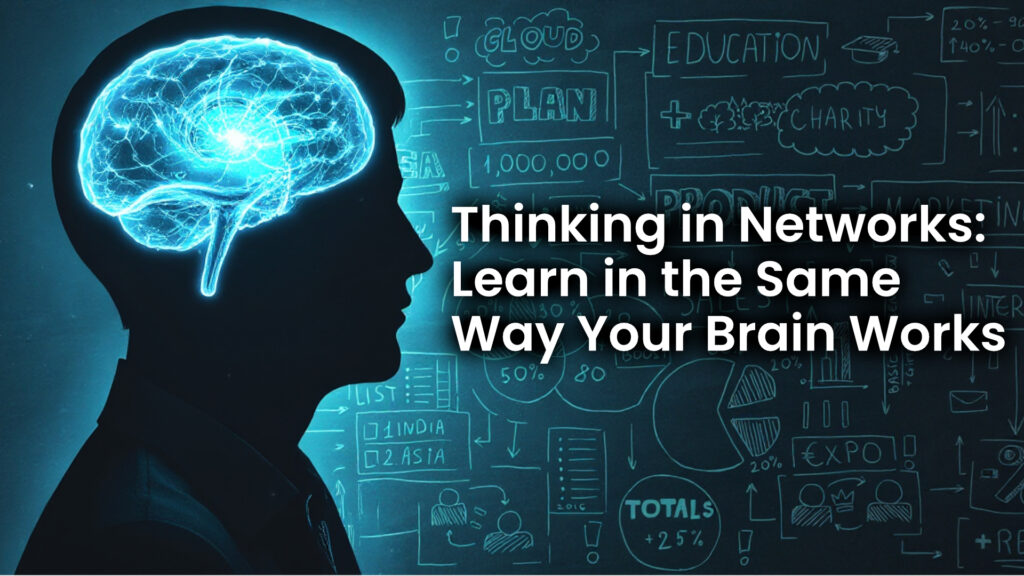
We have long been trained as a species to learn in a straight line. Every notebook you have ever used, every outline, every list follows the same rigid, top‑to‑bottom structure. But did you ever stop to ask whether this approach actually serves how your brain works? The truth might unsettle everything you believe about effective thinking. Because your brain does not work in straight lines. It works in networks, associations and patterns. And forcing it into linear note‑taking may actually be sabotaging your ability to understand, remember and think creatively. Why Linear Notes Don’t Match How Our Brain Thinks Linear note‑taking seems logical. It is neat. It is tidy. But when you write bullet points or numbered lists, you are asking your brain to treat ideas as isolated entries, a format that ignores how your mind naturally builds connections. According to cognitive science, when we encounter new information, our brain immediately begins linking it to existing knowledge through associative thinking. By recording information in a sequential, linear fashion, you silently press the “pause” button on that natural process. Instead of allowing ideas to spread out, overlap and interconnect, you force them into straight lines. That may reduce comprehension, slow down recall and hamper creative insight. How Mind‑Maps Align with Natural Thinking, And What Science Says Mind‑maps are different. When you place a central concept in the middle and branch out related ideas visually, you’re respecting the way your brain stores information. Visual‑spatial processing engages multiple regions of the brain, creating what researchers call bilateral processing advantages. That means both hemispheres are involved, making recall and pattern recognition easier. Studies of mind‑map users suggest it can improve retention and speed of learning. By using spatial relationships, branches, colours and visual cues, a mind‑map effectively mirrors the neural networks forming in your head. Concepts are no longer isolated bullets; they are connected nodes in a mental map, ready for exploration, association and creative synthesis. Bringing Mind‑Maps to Life: The Role of AI Until recently, creating mind‑maps was a manual, time-consuming process. You had to read through dense documents, pick out key ideas, write them on branches, format, rearrange and refine. It worked, but only if you had time. Thanks to advances in artificial intelligence, you no longer need to build mind‑maps by hand. Modern AI tools can automatically scan a PDF, extract key concepts, identify relationships and structure, then generate a visual, brain‑friendly mind‑map in moments. This means any dense document, research papers, policy manuals, study notes, can be turned into a cognitive map within seconds. That makes visual learning scalable, quick and accessible to everyone. https://www.youtube.com/watch?v=XB0j48OoRVs What Mind‑Maps Can Do: Better Learning, Faster Recall, Creative Thinking Once you switch to mind‑maps (or at least blend them into your study habits), you may notice several advantages: Improved retention and recall. Because ideas are connected visually and spatially, you trigger multiple memory pathways. Faster understanding. Complex topics become easier to grasp when you see structure rather than walls of text. Enhanced creativity and insight. Visual connections encourage pattern recognition, analogies and cross‑topic thinking. Flexible revision. You can zoom out for a high-level view or drill down into a branch when needed, useful for revision, project planning or brainstorming. Mind‑maps turn passive reading into active thinking. Instead of memorising isolated facts, you build a mental network of understanding. When Linear Notes Still Make Sense, And How to Mix Methods That said, linear notes still have their place. For quick checklists, simple lists, or step-by-step instructions, linear formats can be efficient. The key is flexibility. Use linear notes when the task demands simplicity. Use mind‑maps when you need understanding, synthesis or creativity. Many learning professionals find that blending both methods works best: use mind‑maps for core comprehension and big-picture thinking, and linear notes for details or quick reference. Begin Thinking in Networks, Not Lines For too long we have been taught that learning means filling pages with neat, sequential notes. But now we know better. Our brains crave connection, association and visual structure. Mind‑maps, especially those generated or supported by AI, offer a powerful, brain‑aligned way to learn, revise and think. So the next time you open a dense document, don’t force yourself to read it like a script. Instead, ditch the linear page. Let your brain breathe. Build a map. Think in networks. You might just discover more than facts, you might unlock insight. To create your own mindmaps and learnign resources, visit www.openelms.ai and start your 14 day free trial of Open eLMS Learning Generator
The One Change That Drastically Improves Traditional Learning

For decades, we have accepted traditional learning as the only way to develop skills: courses, modules, manuals, workshops and assessments. But what if the entire concept is built on an assumption that no longer fits the world we live in? Today, we can access almost any piece of information within seconds. Yet we continue to design learning as if people need to memorise everything just in case they might need it one day. In this article we explore why this approach no longer works, what cognitive science says about it, and how a new model of learning is emerging. The flaw at the heart of traditional learning Most organisational training still follows a front-loaded, just-in-case model. We give employees as much information as possible up front, hoping they will store and recall it later. But research tells us the human brain simply does not work that way. We forget around 80% of information within 30 days, even when the training is well designed. This is not because people are unmotivated or because the learning is poor. It is because the brain is incredibly efficient, and one of its greatest efficiencies is discarding unused information. If someone learns a process on Monday but does not need it until Thursday, their brain often treats that knowledge as irrelevant. It fades because it was not immediately applied. This is the fundamental problem with traditional learning, it assumes memory behaves in a way it simply does not. Why retention collapses: The 24-hour rule IBM research highlights a critical insight. People retain and apply information effectively only when it is delivered within 24 hours of when they need it. After that window, retention declines rapidly, no matter how well designed the original training is. You would never memorise every road sign and rule before driving. Instead, you react to signs as you encounter them. A stop sign appears at exactly the right moment. That is the power of context. That is the power of timing. In the workplace, we too often expect people to recall details from training that may have happened months earlier, even though this runs against everything we know about human cognition. Signposting: What the National Parks can teach us To understand the alternative, picture a visit to a National Park in the United States. Before entering bear country, you do not attend a three-hour safety class. You see a clear sign that says:Bear area. Store food properly. The information appears at the precise moment you need it. This is the core idea behind signposting, or point-of-need learning. Instead of training people in advance, you embed critical knowledge directly inside workflows and systems so it appears when it is relevant. Imagine an employee opening a procurement system and seeing a short reminder about approval thresholds. Or someone uploading a document and receiving a quick prompt about data protection rules. No searching. No guessing. No relying on distant memories. This is learning that works with human cognition, not against it. Watch below to see it explained: https://www.youtube.com/watch?v=N59qIb5ALD4 The cognitive advantage: motivated attention When information is delivered at the moment it is needed, the brain treats it as important. Psychologists call this motivated attention, the heightened focus we experience when information helps solve a problem right now. Studies show that point-of-need information:• Increases task accuracy by 67%• Reduces completion time by 43% Not because the learner works harder, but because the information is timely, relevant and contextual. Turning traditional e-learning into signposted knowledge You do not need to throw away existing training. You transform it. Using tools that already exist today, and through the power of AI, a 45-minute compliance module can become:• A concise summary• A set of quick reminders• A glossary of immediate definitions• A reference document employees can open at any time Instead of assuming people will remember everything, you make it easy for them to retrieve the right detail at the right moment. Some learning management systems, including Open eLMS, even allow you to embed and track e-learning directly inside websites or systems. But signposting is not always linear. Often the learning must be delivered in a flexible, context-dependent way. That is where AI changes everything. How AI automates signposting The Open eLMS Learning Generator can take your existing PDF or training content and automatically extract everything needed for point-of-need deployment:• Key takeaways• Q&A• Important timelines• Keywords• Full transcript for deeper learning You get the best of both worlds: comprehensive training for structured learning and contextual prompts for real-world performance. This is training that works harder. And smarter. The bigger shift: Why memorisation no longer matters We do not live in an information scarce world anymore. We have more knowledge available to us than at any point in human history, instantly accessible through AI, phones, computers and even smart glasses. The challenge is not knowing more. It is knowing the right thing at the right moment. Traditional learning assumes we must store vast amounts of information in our heads. But that idea comes from a pre-digital era. Today, trying to remember everything is not just unnecessary; it is cognitively wasteful. Human brains are built for recognition, decision making and creative problem solving, not for acting like filing cabinets. A perfectly timed reminder when uploading a document is worth more than a four-hour compliance course taken six months ago. The future of learning: Just-in-time knowledge Learning is not dead. It is evolving. We are moving from front-loaded information to contextual prompts, changing from memorisation to performance support, and moving from learning just in case to learning on demand. The future belongs to learning that appears in the flow of work, at the exact moment human performance depends on it. When someone suggests traditional training, ask a simple question: In a world where I can access any information in three seconds, why are we training people to memorise it? The future of learning is not about knowing more.It is about accessing the right information at exactly the right moment. Sign up
How AI Is Changing the Way Students Revise: Smarter, Simpler, More Human
Do you ever sit down to revise a subject and just freeze? The textbook feels too dense. The key points blur together. You are reading, but none of it seems to stick. It is frustrating and exhausting, especially when you genuinely want to get the grade. The good news is that there is a better way to revise. One that does not rely on memorising huge amounts of text or repeating flashcards for hours. Today, AI tools are helping students revise smarter, not harder. Why Revision Feels So Overwhelming Most students are not unmotivated. They are overloaded. Revision often feels like a memory game. You are given long pages of notes and expected to make sense of them on your own. There is little room for clarity, feedback or personalisation. Instead of feeling supported, revision becomes a lonely task. But it does not have to be that way. In fact, revision is most effective when it is interactive, visual and active. Making Complicated Topics Make Sense AI tools are particularly good at breaking down complex topics into simpler explanations. For example, if you are struggling with a paragraph on a scientific process or a literature analysis, you can ask an AI model to explain it in GCSE-level terms. Suddenly, you are not just reading information. You are having it explained to you, like a teacher sitting beside you. The AI can tailor its answer to your level, use examples, and even rephrase it until it makes sense. That is not a shortcut. That is smart study. Smart Study Tools and Instant Feedback Revision works best when you are actively involved in the process. One way AI helps is through real-time quizzing and feedback. You can ask it to quiz you on any topic and it will adjust based on how well you answer. That means no more wasting time on what you already know. Instead, you focus on where you actually need to improve. Platforms like Open eLMS use the same method. Lessons are interactive and come with built-in quizzes, challenges and activities that help you test yourself in a low-pressure way.See it in action in the video below: https://www.youtube.com/watch?v=IvaBcsTkeb8 Visual Tools That Help You See the Bigger Picture One of the hardest things about revision is trying to connect everything together. What causes what? What came first? How does it all fit? AI tools can now generate mind maps, timelines, flow charts and infographics from your content in seconds. Instead of memorising pages of notes, you can see the whole structure of a topic laid out visually. This makes it easier to understand the big picture and remember how the parts relate to each other. Learning the Way You Learn Best Every student learns differently. Some prefer visuals, others need explanations. Some learn best by testing themselves, others through discussion. AI tools adapt to your style. They give you more control over how you revise, letting you focus on the method that works best for you. Whether you prefer written content, audio summaries, questions or visuals, you can create the kind of revision resource that makes sense to your brain. This makes revision less about stress and more about progress. What AI Cannot Do AI is not a replacement for thinking. It will not do your analysis for you. It cannot tell you which argument is stronger or what your exam marker is expecting. But it can help you understand the material, build confidence and focus on what matters most. And when used properly, it is not a shortcut. It is a tool that supports better, deeper learning. Smarter Revision Is Possible The best students are not necessarily those who spend the longest revising. They are the ones who revise with purpose, who know when to ask questions and who find methods that work for them. AI is making that easier. Whether you are preparing for GCSEs, A-Levels or just trying to get a handle on a difficult topic, smart tools are now available to support every stage of revision. You still have to do the work. But with the right tools, you can make that work more efficient, more focused and more effective. Visit www.openelms.ai to find out more.