
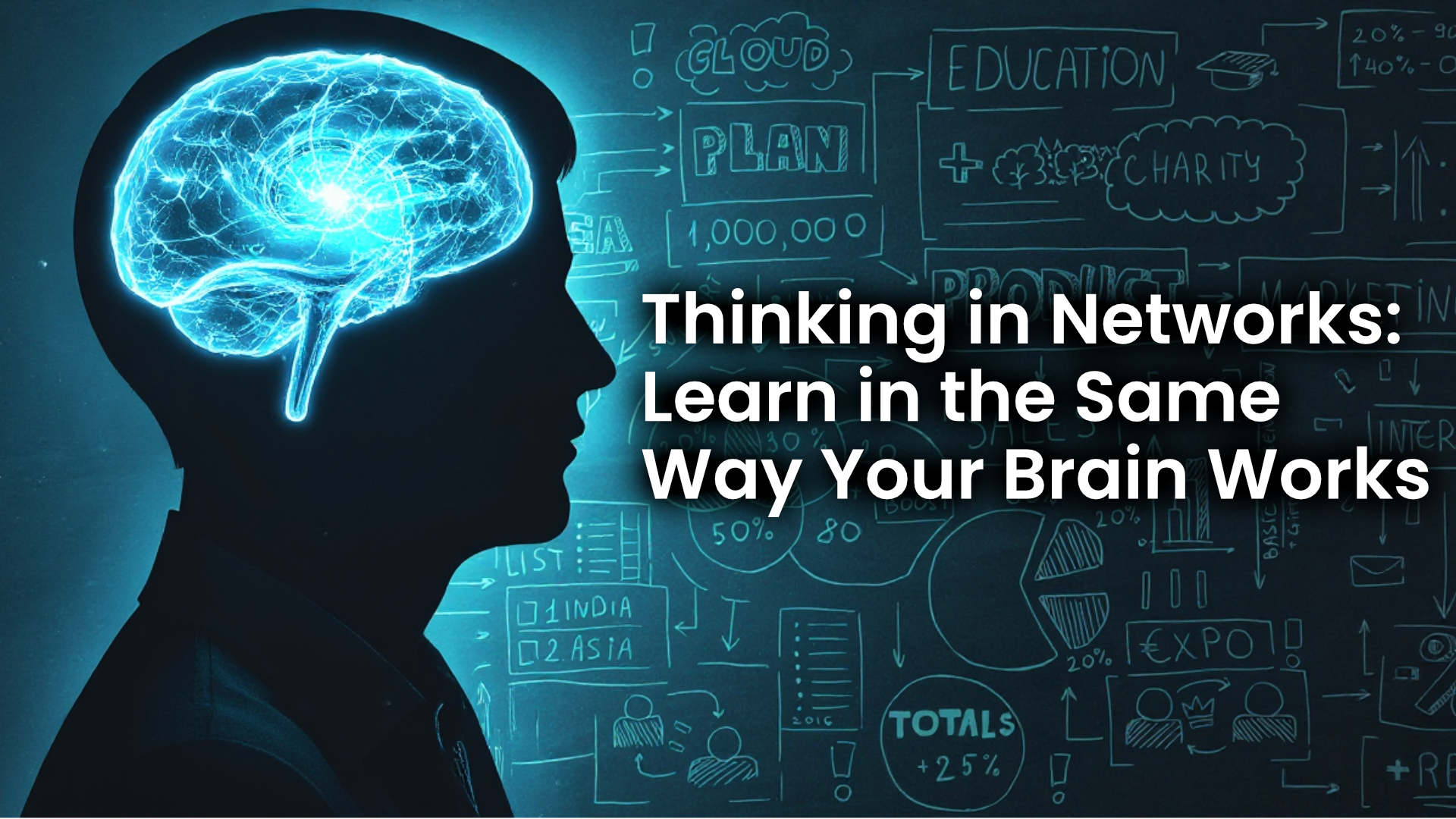

We have long been trained as a species to learn in a straight line. Every notebook you have ever used, every outline, every list follows the same rigid, top‑to‑bottom structure. But did you ever stop to ask whether this approach actually serves how your brain works? The truth might unsettle everything you believe about effective thinking.
Because your brain does not work in straight lines. It works in networks, associations and patterns. And forcing it into linear note‑taking may actually be sabotaging your ability to understand, remember and think creatively.
Why Linear Notes Don’t Match How Our Brain Thinks
Linear note‑taking seems logical. It is neat. It is tidy. But when you write bullet points or numbered lists, you are asking your brain to treat ideas as isolated entries, a format that ignores how your mind naturally builds connections. According to cognitive science, when we encounter new information, our brain immediately begins linking it to existing knowledge through associative thinking.
By recording information in a sequential, linear fashion, you silently press the “pause” button on that natural process. Instead of allowing ideas to spread out, overlap and interconnect, you force them into straight lines. That may reduce comprehension, slow down recall and hamper creative insight.
How Mind‑Maps Align with Natural Thinking, And What Science Says
Mind‑maps are different. When you place a central concept in the middle and branch out related ideas visually, you’re respecting the way your brain stores information. Visual‑spatial processing engages multiple regions of the brain, creating what researchers call bilateral processing advantages. That means both hemispheres are involved, making recall and pattern recognition easier.
Studies of mind‑map users suggest it can improve retention and speed of learning. By using spatial relationships, branches, colours and visual cues, a mind‑map effectively mirrors the neural networks forming in your head. Concepts are no longer isolated bullets; they are connected nodes in a mental map, ready for exploration, association and creative synthesis.
Bringing Mind‑Maps to Life: The Role of AI
Until recently, creating mind‑maps was a manual, time-consuming process. You had to read through dense documents, pick out key ideas, write them on branches, format, rearrange and refine. It worked, but only if you had time.
Thanks to advances in artificial intelligence, you no longer need to build mind‑maps by hand. Modern AI tools can automatically scan a PDF, extract key concepts, identify relationships and structure, then generate a visual, brain‑friendly mind‑map in moments. This means any dense document, research papers, policy manuals, study notes, can be turned into a cognitive map within seconds.
That makes visual learning scalable, quick and accessible to everyone.