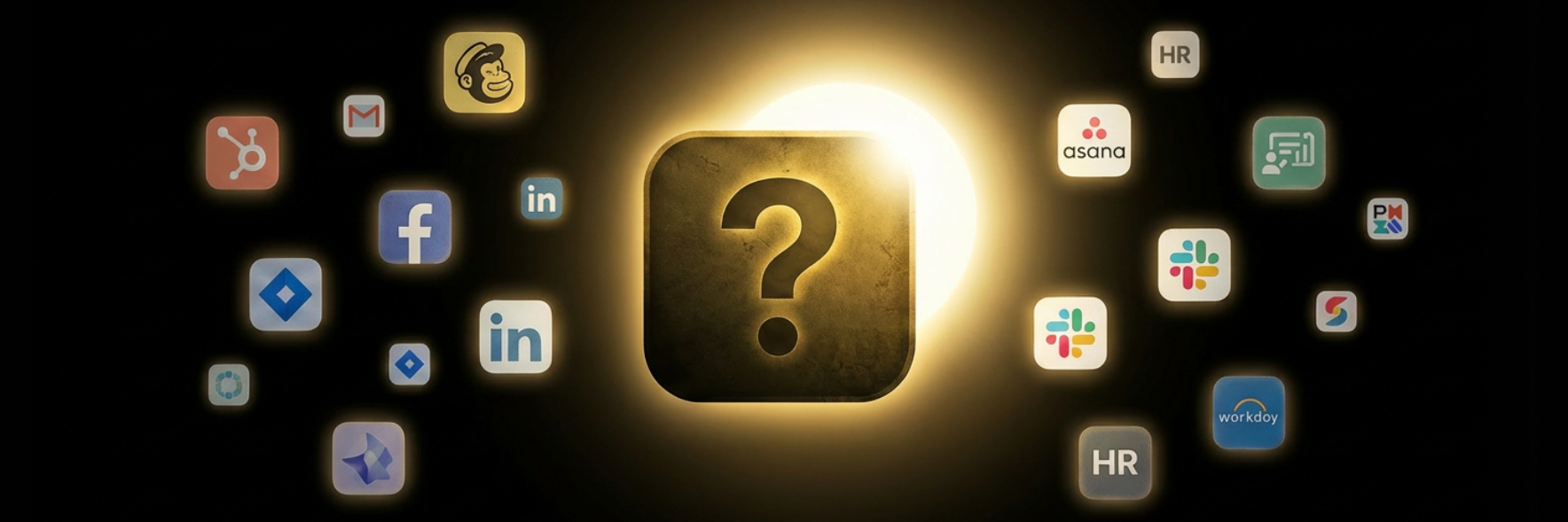


Imagine replacing £100,000 worth of disconnected business software with a single, unified platform built around your own company intelligence.
This is not about shaving costs from your tech stack. It is about transforming how your organisation works.
In this 10-part series, we are going to show you how we built our AI-powered Everything App and how you can build your own. This is the intro, where we explain the vision, the problem, and what the system actually does.
The Hidden Cost of Disconnected Software
Most businesses operate with a patchwork of tools:
-
A CRM that only partly reflects the real sales process
-
A project management tool that lacks context
-
Marketing software that does not connect to delivery
-
Testing processes that are manual and reactive
-
Admin systems that absorb hours every week
Each tool promises efficiency. Together, they create friction.
Data becomes siloed. Automation breaks. Reporting requires effort. Teams duplicate work. Innovation slows down because every change must pass through multiple systems.
The financial cost may be high, but the operational cost is far higher.
What if everything worked together instead?
Introducing the AI-Powered Everything App
The Everything App is a unified business platform powered by company-trained AI.
Instead of layering integrations across separate products, you build one coherent ecosystem where:
-
CRM
-
Project management
-
Marketing
-
Sales
-
Testing
-
Utilities
-
Analytics
all operate inside a single framework.
The key difference is that every module is driven by AI trained on your own business data.
This means automation works the way your company works.
What the Everything App Actually Does
Here is what sits inside the platform.
1. AI-Trained Intelligence
At the core is a company-specific AI assistant.
It understands your processes, terminology and standards. It can generate documents, verify accuracy, manage internal knowledge and ensure compliance automatically.
This is not generic AI. It is your AI.
2. Intelligent CRM
Your CRM becomes proactive rather than reactive.
The system can:
-
Anticipate follow-ups
-
Generate tailored sales emails
-
Draft tender responses
-
Sync insights across teams
-
Use meeting transcripts to drive workflows
You define your sales process. The system adapts to it.
3. Project Management, Supercharged
Kanban boards and structured task lists are enhanced with AI recommendations.
The system understands dependencies, resource requirements and project context because it has access to your company knowledge.
Project setup becomes instant rather than manual.
4. Automated Testing
Quality assurance is built in.
When changes are made to your systems, the AI can:
-
Detect updates
-
Generate test scripts
-
Run validation processes
This enables faster development cycles without sacrificing reliability.
5. Marketing and Content Automation
From scheduling posts to analysing performance data, the platform provides AI-enhanced marketing tools that keep your campaigns aligned with your strategy.
Video editing, content generation and insight discovery become integrated parts of the system.
6. Sales Clarity
Sales funnels, workflows, quotes and proposals all live in one place.
The AI can generate client-specific documentation based on meeting notes and historical context. Reporting becomes automatic and accurate.
7. Utilities Suite
Admin does not need its own ecosystem.
Calendar management, leave requests, expenses, note-taking and custom utilities can all exist inside the same framework.
If you need a new feature, you build or integrate it. You are no longer waiting for a vendor roadmap.
Real-Time Intelligence Across the Business
The Everything App provides live dashboards showing:
-
Employee performance
-
System health
-
Workflow efficiency
-
Delivery metrics
Instead of retrospective reporting, you gain continuous visibility. That changes how decisions are made.
Watch to find out more: