
The Top 5 Learning Technology Trends Shaping Education in 2026
Education and training are not slowly evolving. They are being structurally reshaped. As we move forwards 2026, learning technology is shifting away from static courses, disconnected platforms, and one-size-fits-all content. In their place, we are seeing intelligent, adaptive, and genuinely scalable learning ecosystems emerge. Below are the five learning technology trends that will define the next era of education and workforce training, and how organisations can start benefiting from them today. Key Takeaways at a Glance AI is moving from content assistance to full learning generation One course can now power multiple formats and channels LMS platforms are becoming connected learning ecosystems High-quality education is being democratised at scale Trust and consistency are replacing unverified content libraries 1. AI Is Becoming the Engine of Learning Generation Artificial Intelligence is no longer an add-on to learning design. It is becoming the engine that powers it. Modern AI systems can now generate complete learning experiences from a single source. That includes structured courses, narration, visuals, assessments, summaries, and interactive elements. The result is faster production, lower cost, and far greater personalisation. Instead of static courses, learners receive content that adapts to their role, pace, and level of understanding. In practice, this feels less like consuming training and more like being guided by a digital mentor. Platforms such as Open eLMS Learning Generator already enable organisations to transform documents or prompts into polished learning resources in minutes, complete with professional voiceovers and video. AI now removes the production bottleneck that has limited learning teams for decades. 2. Multi-Channel Learning Is Replacing Single-Format Courses Learners no longer engage with content in one place or one format. The same learning experience may begin as a short video, continue as a podcast, and finish as an interactive scenario or game. Multi-channel development allows a single learning source to be repurposed instantly across formats. This approach dramatically increases reach and effectiveness. Learners can engage with training at their desk, on their commute, or in short bursts throughout the day, without fragmenting the learning journey. For organisations, this means: Faster content creation Consistent messaging across formats Better engagement across different learner preferences Learning is no longer about where people log in. It is about how learning fits naturally into their working lives. 3. Integration and Vibe Coding Are Breaking Down Learning Silos Learning systems are becoming connected, not isolated. Through APIs and vibe coding approaches, learning platforms can now integrate seamlessly with collaboration tools, project management software, and content creation apps. This removes friction between learning, working, and knowledge sharing. This shift also enables faster experimentation and interface validation across learning platforms. Using an AI prototype generator allows teams to quickly visualise and test interface concepts before full development, ensuring learning experiences are both functional and user-centred. This reduces iteration cycles while supporting seamless integration within connected learning ecosystems. Instead of jumping between platforms, learners and creators operate within a unified environment where: Content updates flow automatically Learning aligns with real work Collaboration happens naturally This shift transforms the LMS from a content repository into a living learning ecosystem. Watch: How These Learning Trends Are Already Becoming Reality The trends above are not theoretical. They are already reshaping how organisations design, deliver, and scale learning. https://www.youtube.com/watch?v=h-l8ymlIpf0 4. The Democratization of Learning Is Finally Scaling For years, MOOCs promised global access to education but struggled to deliver depth, relevance, and sustainability. AI has changed that equation. High-quality learning libraries can now be created and maintained at a fraction of the previous cost. This allows organisations, institutions, and governments to provide meaningful education regardless of geography or budget. The result is a genuine democratisation of learning where: Access is no longer limited by location Quality is no longer limited by budget Learning can scale without sacrificing relevance This is particularly transformative for emerging economies, small organisations, and underserved communities. 5. Consistent, Verified Learning Is Replacing Content Chaos The future of learning is not more content. It is better content. As AI accelerates production, trust becomes critical. Learners and organisations need confidence that materials are accurate, up to date, and aligned with real standards. The next generation of learning platforms combines AI efficiency with human oversight. Content is regularly reviewed, updated, and validated, ensuring consistency across the entire learning ecosystem. This marks a shift away from fragmented, unverified repositories towards reliable, living knowledge systems. Bringing It All Together These five trends point to a single conclusion. Learning in 2026 will be: AI-driven but human-controlled Multi-format by default Integrated into daily work Globally accessible Consistent and trustworthy Crucially, this future is not years away. It is already available. Start Experiencing the Future of Learning Today All of these capabilities exist today within Open eLMS. By registering, you can explore AI-generated learning, multi-channel delivery, integrated ecosystems, and scalable education without rebuilding your entire infrastructure. The future of learning is not about replacing people with technology. It is about giving people better tools to teach, learn, and grow. Start that journey today.
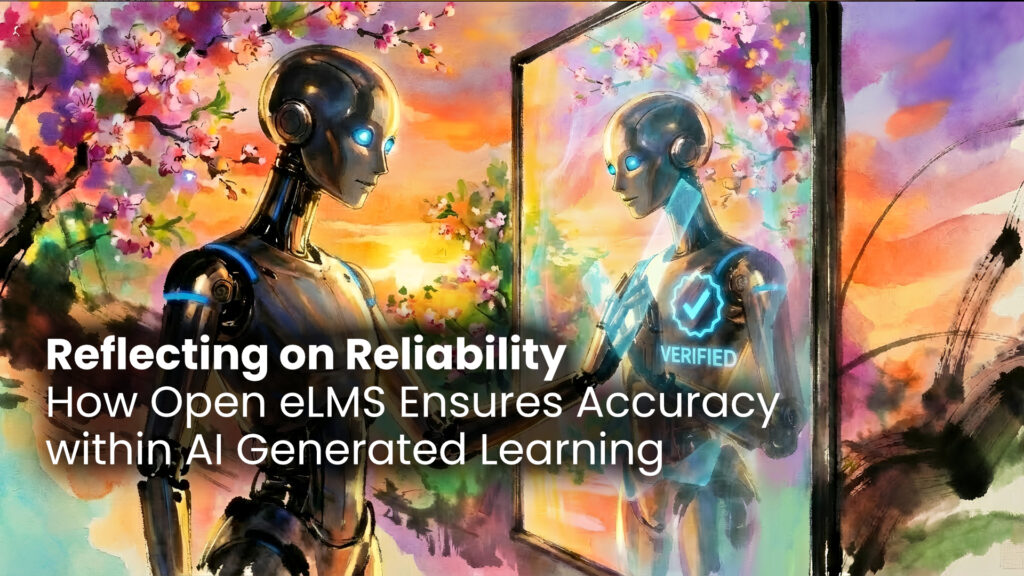
Reflecting on Reliability: How Open eLMS Ensures Accuracy within AI Generated Learning
One of the biggest concerns surrounding AI in education is both simple and justified. What happens when AI gets it wrong? Anyone who has used generative AI knows it can sound confident while being completely incorrect. In education and training, that is not a minor issue. It is a deal breaker. Inaccurate content doesn’t just waste time. It damages trust and creates serious risks for learners and organisations. The future of AI in learning will not be defined by speed alone. It will be defined by trust. And trust is not automatic. It must be built, layer by layer. The Real Problem with AI in Education Most conversations about AI in education focus on how quickly it can create content and how much money it can save. These benefits are real. But they are only part of the picture. The more important question is this: can the content be trusted? AI systems do not understand truth. They are trained on large volumes of text and generate language based on probabilities, not facts. They can hallucinate, repeat outdated information, or introduce errors with surprising confidence. In learning, where accuracy is everything, this is a major challenge. Why One Layer of Checking Is Not Enough In traditional e-learning development, a single instructional designer or subject matter expert often carries the full responsibility for creating and validating content. That already introduces risk. If one person misses something, it stays missed. Simply replacing that person with AI does not fix the issue. It can make it worse. Without careful oversight, AI risks producing scalable, rapid content that is wrong at scale. Trustworthy learning content requires more than one pass. It requires multiple, complementary layers of verification. How Trustworthy AI Learning Is Actually Built The right approach starts by recognising that different content types need different AI tools. Background imagery can be created with visual models trained for contextual design. Diagrams, equations, and technical visuals require AI models trained specifically for structure, logic, or mathematical precision. That’s only the first step. Once the initial content is created, it is reviewed by human experts. Subject matter professionals correct errors, add nuance, and ensure the material aligns with current thinking. Then, a final AI layer is reintroduced. This time, it is used to scan the entire course for inconsistencies, outdated information, or missed connections. It provides suggestions based on the latest available research, creating a continuous quality loop where AI checks human inputs and humans check AI-generated material. This is how hallucinations are caught. This is how blind spots are reduced. This is how accuracy is strengthened over time. https://www.youtube.com/watch?v=RLELr7A3Qs8 Why This Approach Produces Better Learning Content When AI and human expertise work together in this layered way, their strengths support one another. AI brings speed, consistency, and pattern recognition. Humans provide critical thinking, professional judgement, and experience. The result is more robust and more accurate learning content. And because the process is modular and repeatable, it becomes easier to update. When facts change, the content can adapt quickly, rather than sitting untouched for years. Trust is no longer assumed. It is engineered. From Verified Learning to Scalable Delivery Once this multi-verified content is created, it unlocks a much larger benefit. Trusted content becomes the foundation for everything else. Using Open eLMS Learning Generator, this core content can be transformed instantly into a range of learning formats, all built from the same verified source material. A single e-learning course can be converted into a podcast, a short video series, revision notes, flashcards, social media assets, and even assessment questions. Each format supports a different learning style or context. Because the foundation is already thoroughly checked, every version carries the same level of reliability. What This Means for the Future of AI in Learning AI does not need to replace educators to transform education. In fact, its greatest potential lies in supporting them, enhancing their reach, amplifying their expertise, and improving quality at scale. The future belongs to learning systems that treat accuracy as essential, not optional. Systems that combine AI efficiency with human intelligence. Systems where no piece of content is published without being checked from both sides. Trustworthy AI learning content does not happen by chance. It is the result of design, structure, and rigorous process. Ready to See It for Yourself? You do not have to imagine this in theory. You can test it in practice. Try the Open eLMS Learning Generator today and see how a single source document can become verified, high-quality learning content, instantly repurposed across multiple formats. Try the Learning Generator hereLearn more about how it works Whether you work in corporate L&D, education, or content production, this is how to make learning content you can actually trust.
The AI Bubble Is Real: What Happens When It Bursts and Who Wins Afterwards

AI has become the centre of the tech world. Stock prices have surged, valuations have exploded, and billions are being poured into companies promising to own the future of artificial intelligence. But beneath the excitement, something far less comfortable is forming. The AI bubble is real. And when it bursts, it will not be the companies people expect that come out on top. This matters because what comes next will define the next decade of technology, learning, and digital business. Why the AI Bubble Exists Right now, AI is being treated like the next Google or Facebook. A winner takes all market where one or two companies dominate and extract enormous profits forever. Investors are backing this idea at scale, assuming that the company with the biggest model wins. The problem is that AI does not behave like a social network or a search engine. It behaves like infrastructure. AI models are built on publicly available research. Techniques spread fast. Experts move between organisations. Improvements that look proprietary today are replicated within months. There is no lasting secret advantage. Even more importantly, AI is brutally price sensitive. AI Is a Commodity, Not a Monopoly History gives us a clear warning. During the dot-com boom, internet infrastructure was meant to be the gold rush. Internet service providers were valued as if they owned the future. Most of them vanished. The real winners were not the companies providing the internet. They were the ones building on top of it. Amazon, Netflix and Spotify did not sell access. They used access to create value. AI is following the same path. Costs are collapsing. Chinese AI companies are producing models with comparable performance for a fraction of the price. In one recent case, a competitive model was reported to cost one fourteen-hundredth of the cost of a leading Western model. That changes everything. This is not a race to the top. It is a race to the bottom. And in commodity markets, the lowest cost provider always wins. What Happens When the AI Bubble Bursts When investors realise that AI models cannot sustain high margins, the market will correct hard. Valuations will fall. Companies built purely around selling models will struggle. Infrastructure providers will be squeezed until profitability becomes marginal. This will feel dramatic, but it will not mean AI has failed. It will mean AI has matured. Just like electricity, cloud hosting, and internet access before it, AI will become cheap, abundant, and interchangeable. That is when the real opportunity begins. Watch below to find out more: https://www.youtube.com/watch?v=PwW-rzJ8wVQ&feature=youtu.be Who Actually Wins After the Crash The winners will not be the companies selling AI. They will be the companies using AI to make things. The businesses that survive the burst will be model agnostic. They will switch between providers freely, choosing the best or cheapest option at any given time. They will not care who built the model. They will care what the model allows them to produce. This is already happening in learning and education. What This Means for Learning and EdTech For years, producing high-quality digital learning content was expensive. A single course could cost between £50,000 and £100,000 to build. That limited innovation and access. By treating AI as a tool rather than a product, that cost collapses. At Open eLMS, AI is used to generate complete learning programmes including courses, videos, podcasts, and assessments for pennies. The platform does not depend on a single AI provider. It moves fluidly between models, always optimising for cost and quality. The value is not in the AI itself. The value is in what gets built with it. That distinction matters more as AI becomes cheaper. The Only Question That Matters Now When the AI bubble bursts, panic will follow. Headlines will talk about failures and lost value. But underneath the noise, the real shift will already be complete. AI will no longer be the product. It will be the tool. The organisations that thrive will be the ones that understood this early. They will not be selling intelligence. They will be applying it. So if you are building with AI today, ask yourself one question, because it is the only one that will matter when the dust settles. What are you making with it? Try It for Yourself If you are ready to move beyond the hype and start building with AI, try the Open eLMS Learning Generator. Upload your curriculum or PDF, and see how AI can turn your ideas into complete e-learning courses, podcasts, and video content in minutes. The future is not about who has the biggest model. It is about who uses it best. Explore the Learning Generator at openelms.ai