
Step by Step Guide to Vibe Coding With Google Gemini: AI in Training
Artificial intelligence is no longer confined to generating text. It is now entering the space of interactive design, helping trainers and educators build learning experiences that once required coding expertise. One of the most exciting developments is vibe coding with Google Gemini. Vibe coding allows you to give the AI a “vibe” or overall direction, and it does the heavy lifting by generating the code, assets and interactivity. This blog explores how Gemini can be used in training through a step by step guide, with a video demonstration embedded below. What the Video Covers In the video, Emil demonstrates how Gemini can be used in learning and development through vibe coding. The step by step process includes: Creating a structured mindfulness course as the foundation. Generating supporting materials such as course outlines, learning goals and presentations. Turning that content into flashcards, handouts and interactive activities. Applying vibe coding to build fully functional online mini-games. The highlight is watching Gemini create a “Mindful Escape” game where learners must recognise and respond to stress triggers. Iteration improves the design further, making the game more challenging and relevant to workplace stress management. Gemini also attempts a snake-style game where mindfulness questions appear when the snake collides with obstacles, showing how even classic mechanics can be reimagined as learning tools. https://www.youtube.com/watch?v=choImlCJQ_U&list=PL2j5qhe5EPJtm5Qal71mGHjMAx1zCLgaR&index=1 Why Vibe Coding Matters for Training This step by step guide shows how vibe coding can empower trainers without coding expertise. For learning and development teams, the benefits are clear: Rapid prototyping of interactive activities. Gamification of training content to boost engagement. Adaptation of games and quizzes to reflect organisational themes or branding. While Gemini sometimes requires iteration and fixes, it demonstrates how AI can turn ideas into interactive, engaging formats. Vibe coding bridges the gap between imagination and implementation, giving trainers more creative options than ever before. Open eLMS Learning Generator Google Gemini shows what is possible when AI and vibe coding come together. But there is another option for those who want professional-standard results with less back and forth. The Open eLMS Learning Generator can take a single line of text or a PDF and produce a complete, high-quality course in minutes. It automatically includes narration, imagery, animation and interactivity, ready to export as SCORM, video, PowerPoint or microgames. If you want to explore how AI can transform training in a practical and efficient way, you can try the Open eLMS Learning Generator free for 14 days. Try Open eLMS Learning Generator
AI in Training: How to Use Google NotebookLM for Course Creation
The role of artificial intelligence in education and training is expanding at a rapid pace. In our AI in Training series we look at practical applications of AI tools that can make life easier for trainers, teachers and learning and development professionals. Each episode takes a popular AI tool and examines how it works, what it does well, and where it might fall short. In this episode we explore Google NotebookLM, a system designed to help professionals collate, curate and transform content into structured training resources. The Problem: Creating Training Content Efficiently One of the greatest challenges for trainers and learning designers is the time it takes to create professional course materials. Gathering documents, writing lesson plans, and developing supplementary resources such as podcasts, videos and study guides is a process that can take weeks. Most AI tools on the market today can generate content quickly, but they often rely on generic data and do not allow you to anchor learning material to your own sources. This creates a risk of inaccuracy and makes it difficult to ensure courses are specific to your learners’ needs. Google NotebookLM attempts to solve this problem by letting you import your own materials, ringfence them, and then use AI to generate tailored outputs such as schedules, videos, podcasts, mind maps and reports. Google NotebookLM in Action Here is the full walkthrough from our AI in Training series, where we build a time management course using Google NotebookLM. https://www.youtube.com/watch?v=vAaxt2g1y8g&list=PL2j5qhe5EPJu2z227YRWEkuCgg2xnB0dm Why This Matters for Learning Professionals NotebookLM demonstrates how AI can speed up course creation while still keeping the trainer in control of the source material. Instead of starting from scratch, professionals can: Upload their own documents and data sources Curate information to ensure relevance Generate multiple learning resources from a single notebook Save time while still producing accurate, professional content For trainers, teachers and L&D teams this means less time spent on manual course development and more time available for teaching, coaching and learner engagement. This is not about replacing trainers, but about equipping them with smarter tools that extend their capability. There’s Another Way: Open eLMS Learning Generator At Open eLMS we believe that AI should empower learning professionals to create engaging, multimodal courses quickly and effectively. That is why we built the Open eLMS Learning Generator. With a single line of text or a document upload, the Learning Generator instantly produces a full professional e-learning course complete with video presenters, quizzes, animations and voiceovers in any language. You can edit the content online and export it as e-learning, a PowerPoint presentation or a video. Soon, you will also be able to export it as a podcast or even a game-based experience. You can try the Learning Generator free for 14 days and see how AI can transform the way you build training. Try Open eLMS Learning Generator
Step-by-Step Guide to Using ChatGPT for Creating Tailored Learning Content
The Challenge of Training Design In business training, one of the biggest challenges is making content relevant for learners. Generic courses often fail to meet expectations, which leaves participants disengaged. Effective training isn’t just about sharing information – it’s about aligning material with specific learner needs. ChatGPT provides trainers and learning professionals with a powerful way to streamline preparation while delivering personalised content. Instead of spending hours creating surveys, designing slides or restructuring agendas, ChatGPT can take on the heavy lifting. Trainers stay in control, but the AI saves time and ensures each session is better targeted. What the Video Covers In the video below, I demonstrate how to use ChatGPT to design a time management course. The walkthrough covers: Generating pre-course surveys to understand learner needs Analysing survey data and applying insights to course design Creating a one-day session plan tailored to participants Producing PowerPoint slides automatically Developing handouts such as glossaries and planners Rehearsing scenarios with role-play to prepare for challenging learners Drafting marketing emails to promote the training to specific industries https://www.youtube.com/watch?v=r5MjxiafnVA&t=9s&list=PL2j5qhe5EPJu2z227YRWEkuCgg2xnB0dm Practical Benefits of ChatGPT in Training The value of ChatGPT lies in more than speed. By tailoring every element of a course, trainers can: Deliver sessions that feel highly relevant to each audience Scale training design without adding extra staff Adapt existing content quickly to new contexts Focus more on facilitation and learner engagement rather than admin ChatGPT also enhances trainer confidence by enabling rehearsal. Role-playing interactions with “difficult students” allows facilitators to refine their communication strategies before stepping into the classroom. What This Means for Learning Professionals For learning and development teams, ChatGPT opens the door to agile training design. No longer restricted by rigid, pre-set materials, trainers can adapt courses in minutes. Whether it’s creating session outlines, generating slides or producing supporting resources, ChatGPT acts as a capable assistant – leaving the trainer free to focus on impact. The Bigger Picture ChatGPT is one tool in a growing landscape of AI for learning. Platforms such as Google NotebookLM and Anthropic’s Claude offer complementary features, from knowledge organisation to coding support. Together, these tools provide exciting opportunities to enhance and scale training delivery. If you’re working in business training or presentations, now is the time to start experimenting. Begin with surveys and outlines, then expand into slide creation, role-play and marketing. The more you explore, the more you’ll discover how AI can transform your learning design process. Try a Faster Way to Create eLearning While ChatGPT is a powerful assistant for building tailored training, there’s an even simpler way to create professional eLearning from start to finish. With Open eLMS Learning Generator, you can produce high-quality, fully designed courses in minutes. Just type a single line of text and the platform does the rest – from structuring content to generating polished eLearning ready for your learners. Try it free for 14 days and see how quickly you can transform your training. Try Open eLMS Learning Generator
Open eLMS MD Interview on Generative AI tool openelms.ai
Our Managing Director, Emil Reisser-Weston, was interviewed recently by Learning News regarding it’s AI powered elearning authoring system: openelms.ai. In this interview Emil explains how AI is used to automatically generate a script, organize learning objectives, and divide them into different sections within the course. It also generates visuals, videos, and animations, mimicking the process used by human designers who apply design heuristics. Despite sounding unbelievable, the tool has proven to be effective. To gain a comprehensive understanding of this innovative tool, watch the video where Emil Reisser-Weston explains its features and functionality, then visit www.openelms.ai and try it out.
openelms.ai – the first elearning designed 100% using AI
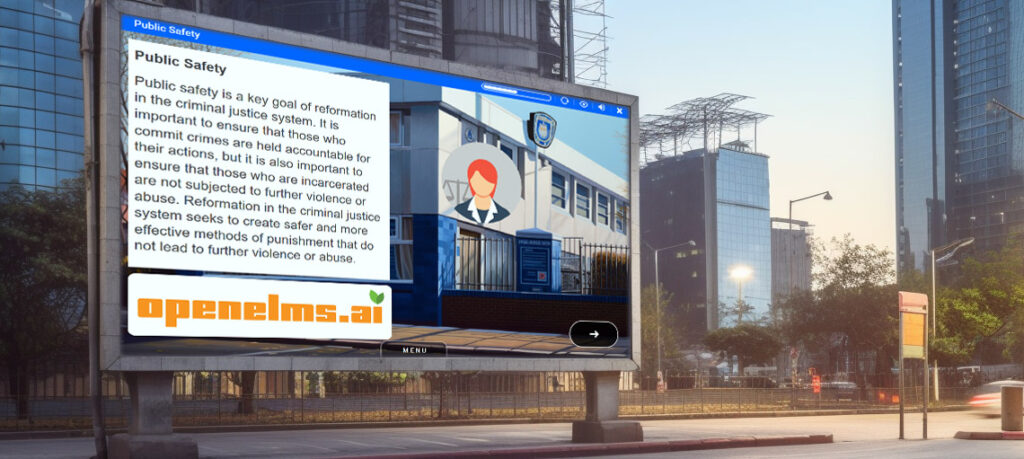
Introduction Since the recent renaissance of AI the clock has been ticking to produce a product that creates real eLearning from a text prompt. The technology exists for producing research scripts on any topic, images and video based on that text and AI can now read an image which allow it to select the right animation for each image and place elements in accordance with good design heuristics. openelms.ai – years in the making Open eLMS recognised the potential early and has been developing openelms.ai for a few years. Furthermore the design system is built on it’s online eLearning authoring tool – Open eLMS Creator – which has been pushing the boundaries of what is possible in eLearning design for the last 15 years. This means any AI generated course can be edited after delivery, using a simple drag and drop style interface. How does it work? openelms.ai requires no prior instruction, simply enter your eLearning requirement, select the length of the course (number of slides) and whether you want a quiz at the end. openelms.ai will then get to work and generate the course for you, this will include video presenters, images, animation and background scenes in which you are setting your learning. The system will also design several options for each screen so you can select the most appropriate or, if none of the designs are suitable, you can generate your own using Chat GPT’s own image generator. If any of this sounds complex, don’t worry it’s not. The process should take less than 60 second from start to finish. What does the eLearning look like? The eLearning is an immersive and engaging experience, basing the learning in virtual learning worlds. This is not a presentation or vertical scrolling experience, the learning is closer in feel to an interactive documentary. In an independent study carried out by the UK’s largest provider of social housing, this eLearning was found to have approval rates of 99%. Furthermore the eLearning has all the features you would expect in any eLearning such as interactive quizzes and knowledge checks. And this is only the start, openelms.ai will be introducing customised computer generated presenters so you can star in your own eLearning and video production elements as the AI technology evolves. How can I access openelms.ai for free? openelms.ai are offering a free version of this system at the launch. Simply go to www.openelms.ai and register to generate your eLearning. The eLearning course can then be downloaded and ran within any Learning Management System. We implore you to give it a go, it will take 60 seconds to change your approach to eLearning creation for life. Access Details www.openelms.ai Further Information openelms.ai – the first eLearning designed 100% using AIopenelms.ai – an early view!Learning News: 5 Artificial Intelligence tools you need to start using now to build eLearning
openelms.ai – the first elearning designed 100% using AI

openelms.ai has recently created the world’s first eLearning courses designed entirely using AI from a single line of text. These short courses took a matter of seconds to produce from a single line of text. The eLearning is available for preview on their website, and they provide a glimpse of the capabilities of the OpenElms.ai platform. The eLearning consists of 7 screens and are for demonstration purposes, the finished system will allow creators to produce courses of any length. The AI-designed courses are comprehensive, easy to navigate, and engaging. The courses utilize a range of multimedia, such as videos, infographics, and interactive quizzes, to enhance the learning experience. The system is due for release at the end of April 2023.
openelms.ai – an early view!
https://youtu.be/e1_s699cBE0 openelms.ai is an eLearning creation system which delivers learning courses of breathtaking quality from a single line of text. This Adobe Captive / Articulate killer is a read game-changer for education and corporate training. The system is due for release at the end of April 2023.
How we are using AI to Create eLearning
Artificial Intelligence can create elearning in seconds – we will show you how This video demonstrates the unique systems and services used by Open eLMS to produce truly engaging e-learning. See www.openelms.ai for further details. Other links of relevance include: MidJourney – excellent image maker Dalle-2 – Open AI’s alternative Chat GPT – need we say any more? D-id – talking heads for eLearning descript – voiceover using text in your own voice openelms.ai – eLearning with a single line of text
Is AI the great EdTech disrupter?
In this video, Emil Reisser-Weston – Open eLMS Product Director – discusses how AI will shape the EdTech industry with references to openelms.ai.
The advantages of AI for elearning creation

Introduction Artificial Intelligence (AI) has been rapidly transforming various industries, and eLearning is no exception. With AI-powered tools, elearning content creation has become faster, easier, and more personalized than ever before. In this article, we will explore the benefits of AI in eLearning content creation and how it can improve the learning experience for students. Personalized Learning One of the most significant benefits of AI in eLearning content creation is personalized learning. With AI-powered tools, educators can create personalized content based on a student’s learning style, preferences, and performance data. This allows students to learn at their own pace and level, improving their engagement and overall learning outcomes. Personalized learning also helps educators identify knowledge gaps and provide targeted interventions to improve student understanding. Increased Efficiency AI-powered eLearning content creation is more efficient than traditional methods. It can create content quickly, accurately, and consistently, allowing educators to focus on other aspects of their job, such as teaching and engaging with students. This efficiency saves time and reduces costs, making eLearning more accessible to a broader audience. Elearning can be created in seconds using openelms.ai Enhanced Engagement AI-powered eLearning content creation can significantly enhance student engagement. With interactive content, such as videos and simulations, students are more likely to retain information and engage with the material. AI-powered content can also adapt to a student’s performance, providing feedback and adjusting the difficulty level of the content accordingly. This personalized approach can improve student motivation and interest in learning. Improved Accessibility AI-powered eLearning content creation can improve accessibility for students with disabilities. For example, text-to-speech technology can convert written content into audio format, making it accessible to students with visual impairments. This technology can also benefit students with dyslexia or other learning disabilities, providing them with alternative ways to learn and engage with the material. All openelms.ai courses include voiceovers and video presenters in up to 27 different languages Consistent Quality AI-powered eLearning content creation provides consistent quality across all content, regardless of the amount produced. The use of AI-powered tools ensures that content is created in a standardized format and is free of human error, ensuring high quality and accuracy. This consistency is essential in eLearning, where learners expect high-quality content that is easy to understand and learn from. AI elearning creation tool – openelms.ai – produces elearning of consistent quality Cost Savings AI-powered eLearning content creation can be cost-effective for educational institutions. The use of AI-powered tools reduces the need for human labor, saving time and costs associated with traditional content creation methods. Additionally, AI can generate content at a faster pace than humans, enabling educators to create more content in less time. Conclusion AI-powered eLearning content creation has numerous benefits, including personalized learning, increased efficiency, enhanced engagement, improved accessibility, consistent quality, and cost savings. With AI-powered tools, educators can create engaging and effective eLearning content that meets the needs of individual learners, providing an optimal learning experience. As AI technology continues to evolve, we can expect to see even more innovative solutions for eLearning content creation.